
Peace as Governance:
-
 Writen byChandra Lekha Sriram
 - PublisherPalgrave Macmillan
- Year2008
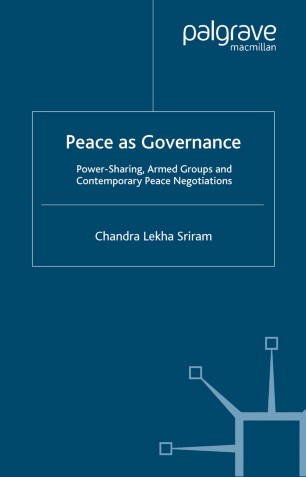
Chandra Lekha Sriram’s Peace as Governance critically examines power-sharing and governance-based peace incentives as strategies for resolving armed conflicts. The book evaluates inclusion strategies designed to bring armed groups into peace processes, questioning their effectiveness in achieving long-term stability. Through case studies in Sri Lanka, Sudan, and Colombia, Sriram highlights both the successes and failures of power-sharing approaches, exposing their unintended consequences, such as the reinforcement of warlord politics or the marginalization of certain groups. The author argues that while governance incentives can be useful, they require nuanced, case-specific applications rather than one-size-fits-all solutions. In contemporary conflict resolution, power-sharing agreements remain a primary tool in peace negotiations, seen in recent cases like Afghanistan, South Sudan, and Libya. However, as Sriram’s analysis shows, power-sharing does not always lead to sustainable peace, and governance-based solutions must account for historical, political, and societal complexities. This book is particularly relevant for policymakers, peace negotiators, and scholars exploring the effectiveness of inclusion incentives in conflict resolution. This book is a valuable resource for understanding the complexities of peace governance. It provides an in-depth, critical analysis of power-sharing mechanisms and their application in real-world conflicts, making it an essential read for those studying peacebuilding, international diplomacy, and conflict resolution strategies.