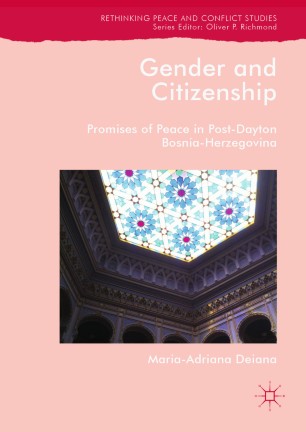
Gender and Citizenship:
-
 Writen byMaria-Adriana Deiana
 - PublisherPalgrave Macmillan
- Year2018
Gender and Citizenship: Promises of Peace in Post-Dayton Bosnia-Herzegovina" critically examines the transformation of women's citizenship following the conflict and international intervention in Bosnia-Herzegovina. Author Maria-Adriana Deiana offers a feminist critique of consociationalism—the power-sharing model established by the Dayton Peace Agreement—arguing that it has entrenched ethnonational divisions and reinforced patriarchal structures. Through an analysis of women's diverse experiences, the book explores how the intersection of conflict, ethnonationalism, and international peacebuilding efforts has shaped notions of belonging, exclusion, and agency among women in post-conflict Bosnia-Herzegovina. Deiana emphasizes the need for reimagining citizenship beyond ethnonational lines to foster genuine inclusion and equality. In today's global landscape, where many societies are grappling with the aftermath of conflict and the challenges of rebuilding inclusive governance structures, this book offers valuable insights. The analysis of Bosnia-Herzegovina serves as a case study for understanding the broader implications of international interventions and peace agreements that prioritize power-sharing among dominant groups, often at the expense of marginalized populations, including women. Deiana's work underscores the importance of integrating gender perspectives into peacebuilding and governance to achieve sustainable and equitable societies Gender and Citizenship" is a significant contribution to the fields of gender studies, peace and conflict studies, and political science. Deiana's interdisciplinary approach provides a nuanced understanding of the complexities surrounding citizenship and gender in post-conflict settings. The book is well-researched, drawing on empirical data and theoretical frameworks to challenge conventional narratives about peacebuilding and governance. It is an essential read for scholars, policymakers, and practitioners interested in promoting inclusive and gender-sensitive approaches in post-conflict reconstruction.