
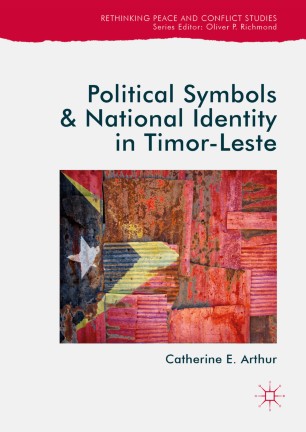
Political Symbols and National Identity in Timor-Leste
-
 Writen by Catherine E. Arthur
 - PublisherPalgrave Macmillan Publication
- Year2019
Political Symbols and National Identity in Timor-Leste by Catherine E. Arthur examines the formation and negotiation of national identity in post-conflict Timor-Leste through the lens of political symbols. Integrating modernist perspectives on nations and nationalism with Bourdieusian theories of symbolic capital and conflict, Arthur analyzes how various symbols—such as flags, monuments, national heroes, and street art—have been utilized to construct and represent national identity. The book delves into how the diverse population of Timor-Leste has interpreted and reshaped its national identity during the first decade of independence, addressing challenges like victimhood, democratization, spirituality, and generational divisions. Relevance with the Current Era In today's globalized world, understanding the role of political symbols in nation-building remains crucial, especially for post-conflict societies striving to establish cohesive national identities. Timor-Leste's experience offers valuable insights into the complexities of identity formation, the power of symbolism, and the ongoing challenges faced by emerging nations. The themes explored in this book are pertinent to scholars and practitioners involved in peace studies, political science, and cultural anthropology, providing lessons applicable to other contexts undergoing similar transitions. Final Verdict Catherine E. Arthur's work is a comprehensive and insightful analysis of the interplay between political symbols and national identity in Timor-Leste. Her interdisciplinary approach, combining political science with cultural studies, offers a nuanced understanding of the nation's post-conflict identity formation. The book's thorough research and critical perspectives make it a valuable contribution to the fields of nationalism studies and Southeast Asian studies.