
The paradox of tolerance?
-
 Writen byHelena Desivilya Syna
 - PublisherJohn Wiley & Sons
- YearMarch 2023
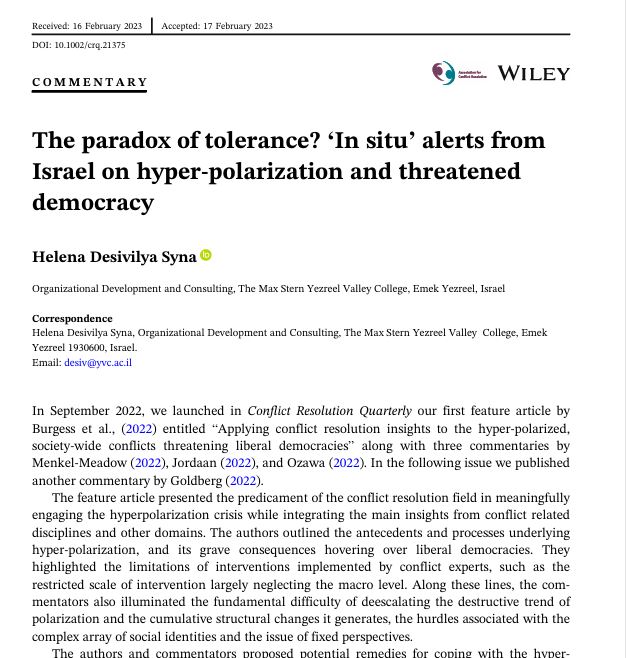
This article explores the paradox of tolerance within the context of increasing hyper-polarization and democratic tensions in Israel. Drawing on real-time observations, the author examines how democratic societies struggle to balance tolerance for diverse viewpoints with the need to protect democratic institutions from extremist ideologies that seek to undermine them. The article highlights the dangers posed by political polarization, ideological rigidity, and erosion of trust between social groups, emphasizing how these dynamics can escalate into deeper societal conflict and threaten democratic stability. The article is highly relevant to the GRACE Repository because it directly addresses the mechanisms through which polarization and intolerance contribute to radicalization, extremism, and social fragmentation. It underscores the importance of moderation, dialogue, and institutional safeguards to preserve peaceful coexistence. The insights are particularly useful for understanding early warning signs of radicalization, identifying societal vulnerabilities, and designing intervention strategies that promote tolerance while preventing extremist exploitation of democratic freedoms.Strengths: • Directly addresses ideological polarization and extremism risks in democratic societies. • Provides real-world insights into conflict escalation and societal fragmentation. • Relevant for early warning frameworks and prevention of radicalization. • Published in a credible peer-reviewed conflict resolution journal. • Useful for policymakers, educators, and rehabilitation practitioners. Limitations: • Short article (commentary format), limited empirical data. • Focused specifically on Israel, requiring contextual adaptation for broader application. • More analytical than operational in providing intervention models. This article is highly suitable for the GRACE Repository. It offers important conceptual and practical insights into polarization, tolerance, and extremism prevention, supporting GRACE objectives related to peacebuilding, coexistence, radicalization prevention, and strengthening resilient communities.