
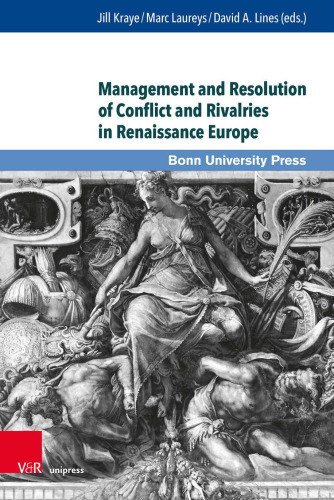
Management and Resolution of Conflict and Rivalries in Renaissance Europe
-
 Writen byJill Kraye, Marc Laureys, David A. Lines
 - PublisherV&R unipress
- Year2023
This scholarly edited volume explores how conflicts, rivalries, and political tensions were managed and resolved in Renaissance Europe, focusing on intellectual, political, diplomatic, and social approaches to dispute resolution. Drawing on humanist writings, political philosophy, and historical case studies, the book examines how scholars, political leaders, and diplomats developed frameworks for mediation, negotiation, and peaceful settlement of disputes. It highlights the role of Renaissance humanism in promoting dialogue, ethical governance, and peaceful coexistence, emphasizing reason, diplomacy, and intellectual engagement as alternatives to violence. The work also examines ideological rivalries, academic disputes, and interstate conflicts, illustrating how early modern European thinkers contributed to traditions of nonviolent conflict resolution. For the GRACE Repository, this book is highly relevant because it provides historical insight into intellectual and diplomatic traditions that promoted peaceful conflict management, dialogue, and coexistence. Understanding these historical foundations helps contextualize modern peacebuilding, rehabilitation, and counter-extremism efforts by demonstrating how intellectual traditions have long emphasized moderation, dialogue, and peaceful dispute resolution.Strengths: • Provides deep historical insight into conflict resolution traditions and intellectual peacebuilding. • Highlights the importance of dialogue, diplomacy, and mediation in managing rivalries. • Demonstrates how intellectual and ethical frameworks contributed to peaceful coexistence. • Offers valuable academic perspectives useful for understanding the evolution of peacebuilding concepts. Limitations: • Written in German, which may limit accessibility for English-speaking researchers. • Focuses on historical conflict resolution rather than contemporary extremism or deradicalization. • Academic and specialized language may require background knowledge in intellectual history.