
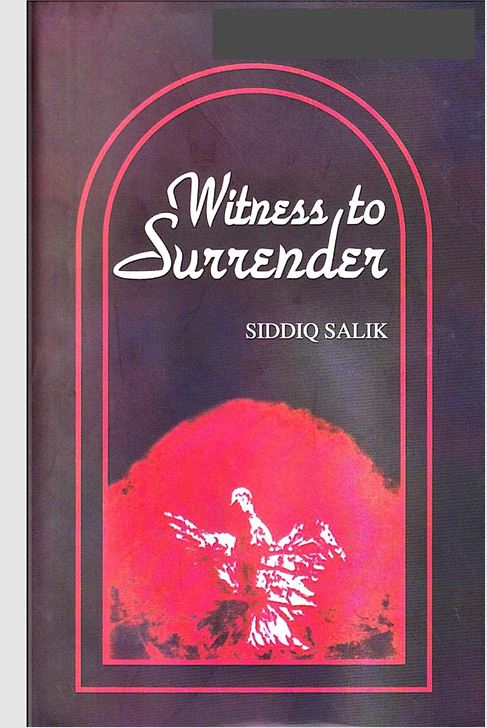
Witness to Surrender
-
 Writen bySiddiq Salik
 - PublisherOxford University Press Pakistan (later editions)
- Year1977
Witness to Surrender is a first-hand account of the events leading up to and during the 1971 war between Pakistan and India, which resulted in the creation of Bangladesh. Written by Siddiq Salik, a Pakistani army officer who was present in East Pakistan (now Bangladesh), the book provides a detailed narrative of the political tensions, military operations, and eventual surrender of Pakistani forces in Dhaka. The book highlights the internal political divisions, governance failures, and miscalculations that contributed to the escalation of conflict. It also reflects on the human cost of war, including suffering, displacement, and societal breakdown. As a personal and military narrative, it offers insight into how misunderstandings, lack of dialogue, and rigid political positions can lead to catastrophic outcomes. For the GRACE Repository, the book is relevant as a historical case study illustrating how political polarization, governance failure, and lack of conflict resolution mechanisms can lead to violent conflict and state disintegration. It provides important lessons on the consequences of unresolved grievances and the importance of dialogue, inclusion, and peaceful conflict management.Strengths: First-hand eyewitness account of a major historical conflict. Provides valuable insight into decision-making and conflict escalation. Highlights the human and societal costs of war. Useful for understanding historical roots of regional instability in South Asia. Limitations: Reflects a subjective perspective (from a Pakistani military viewpoint). Limited analytical framework compared to academic studies. Does not directly address modern extremism or rehabilitation concepts. The book contributes indirectly to peacebuilding and extremism prevention by illustrating how political exclusion, identity conflicts, and governance failures can escalate into violent conflict. Understanding such historical cases helps inform strategies for preventing similar crises, promoting dialogue, and strengthening social cohesion. It is particularly useful for contextual and historical awareness rather than direct rehabilitation frameworks.