
Why Do States Build Nuclear Weapons?
-
 Writen byScott D. Sagan
 - PublisherHarvard University / MIT Press
- Year54–86
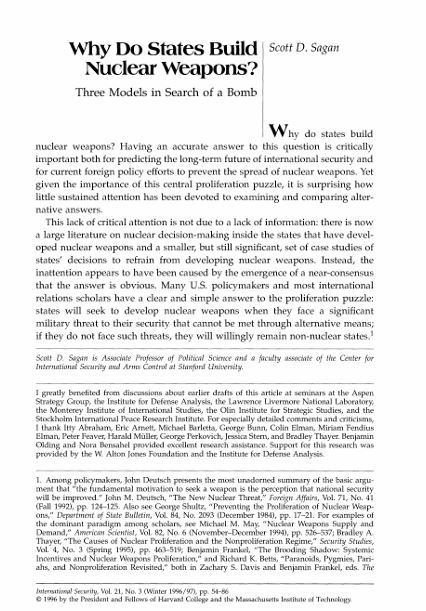
In this influential article, Scott D. Sagan examines why states pursue nuclear weapons and challenges the dominant assumption that security concerns alone drive proliferation. He introduces three theoretical models: Security Model – States acquire nuclear weapons to protect themselves from external threats. Domestic Politics Model – Internal political actors (military, bureaucracies) influence nuclear decisions for their own interests. Norms Model – States pursue nuclear weapons to gain prestige, legitimacy, and international status. The article argues that nuclear proliferation is a multi-dimensional phenomenon, shaped not only by rational security calculations but also by internal politics and symbolic motivations. This broader understanding helps explain why some states pursue nuclear weapons even when security threats are not immediate. For the GRACE Repository, this work is highly relevant as it provides a foundational framework for understanding the causes of strategic conflict escalation and the risks associated with nuclear proliferation. It highlights the importance of diplomacy, institutional control, and norm-building in preventing large-scale violence and maintaining global peace. Strengths: A foundational and highly cited work in security and proliferation studies. Introduces a multi-theoretical framework, improving analytical depth. Challenges simplistic assumptions about state behavior. Highly relevant for policymakers and scholars in international security. Limitations: Focuses on state-level behavior, not non-state actors or extremist groups. Primarily theoretical, with limited empirical case studies in this article. Less direct application to grassroots peacebuilding or rehabilitation contexts. The article contributes to peacebuilding at the macro (global) level by explaining the drivers of nuclear proliferation and potential conflict escalation. Preventing nuclear arms races and promoting non-proliferation agreements are critical to reducing large-scale violence and global instability. While it does not directly address radicalization or rehabilitation, it is essential for understanding structural causes of conflict and the importance of diplomacy and international norms in maintaining peace.