
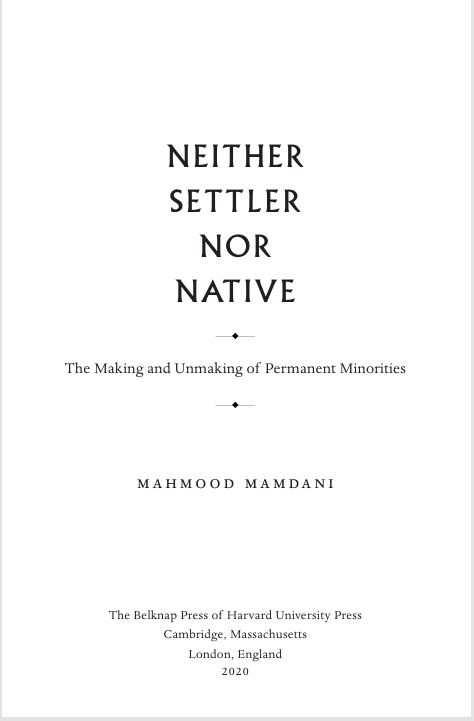
Neither Settler nor Native:
-
 Writen byMahmood Mamdani
 - PublisherHarvard University Press (Belknap Press imprint)
- Year2020
This book presents a powerful rethinking of modern political violence by arguing that colonialism and the nation-state are historically intertwined, producing “permanent minorities” through identity-based political systems. Mahmood Mamdani challenges conventional frameworks that treat violence as exceptional, instead showing how the structure of the nation-state itself has normalized exclusion, ethnic division, and conflict. He traces this process historically—from 1492 and colonial expansion to modern cases such as the United States, Nazi Germany, South Africa, Sudan, and Israel/Palestine.A central argument is that political systems create rigid categories of “settler” and “native,” which institutionalize inequality and fuel cycles of violence. Mamdani proposes moving beyond these identities toward a shared political community of equal citizens, emphasizing political (not purely legal or punitive) solutions to mass violence.Strengths: Offers a highly original theoretical framework linking colonialism and modern conflict. Uses comparative global case studies to strengthen analysis. Challenges dominant legal and punitive approaches to mass violence. Provides a transformative vision of political community and coexistence. Widely recognized and shortlisted for major academic awards. Limitations: Strongly theoretical and abstract, may be difficult for beginners. Some arguments are controversial and debated in academic circles. Limited direct policy or operational guidance for practitioners.This book is highly relevant for understanding root causes of extremism and violent conflict. By explaining how identity-based political systems generate exclusion and grievance, it helps inform strategies for: Preventing radicalization rooted in identity conflicts Promoting inclusive citizenship and coexistence Designing long-term peacebuilding frameworks However, its contribution is primarily conceptual and structural, rather than focused on practical deradicalization or rehabilitation programs.