
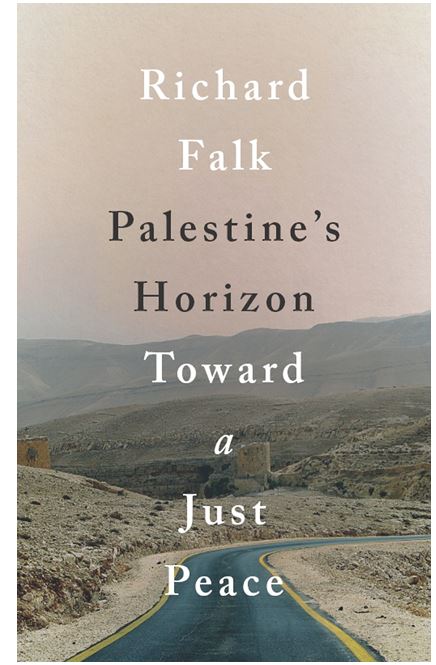
Palestine’s Horizon: Toward a Just Peace
-
 Writen byRichard A. Falk
 - PublisherPluto Press
- Year2017
This book synthesizes decades of work by Richard Falk on the Israeli–Palestinian conflict, offering a critical analysis of why traditional diplomacy has failed and what alternative pathways might lead to a just peace. Falk argues that state-led peace processes have largely failed, and instead highlights the importance of grassroots activism, international law, and global solidarity movements. A key focus is on the shift toward nonviolent strategies, including legal action through international institutions such as the United Nations and International Criminal Court, as well as civil society initiatives like the Boycott, Divestment, and Sanctions (BDS) movement. The book also reflects on the intellectual legacy of Edward Said, emphasizing humanism and coexistence as foundations for peace. Falk challenges the idea that the Palestinian struggle is a “lost cause,” proposing instead that a just and sustainable peace depends on restructuring power relations and advancing rights-based approaches.This book synthesizes decades of work by Richard Falk on the Israeli–Palestinian conflict, offering a critical analysis of why traditional diplomacy has failed and what alternative pathways might lead to a just peace. Falk argues that state-led peace processes have largely failed, and instead highlights the importance of grassroots activism, international law, and global solidarity movements. A key focus is on the shift toward nonviolent strategies, including legal action through international institutions such as the United Nations and International Criminal Court, as well as civil society initiatives like the Boycott, Divestment, and Sanctions (BDS) movement. The book also reflects on the intellectual legacy of Edward Said, emphasizing humanism and coexistence as foundations for peace. Falk challenges the idea that the Palestinian struggle is a “lost cause,” proposing instead that a just and sustainable peace depends on restructuring power relations and advancing rights-based approaches.This book synthesizes decades of work by Richard Falk on the Israeli–Palestinian conflict, offering a critical analysis of why traditional diplomacy has failed and what alternative pathways might lead to a just peace. Falk argues that state-led peace processes have largely failed, and instead highlights the importance of grassroots activism, international law, and global solidarity movements. A key focus is on the shift toward nonviolent strategies, including legal action through international institutions such as the United Nations and International Criminal Court, as well as civil society initiatives like the Boycott, Divestment, and Sanctions (BDS) movement. The book also reflects on the intellectual legacy of Edward Said, emphasizing humanism and coexistence as foundations for peace. Falk challenges the idea that the Palestinian struggle is a “lost cause,” proposing instead that a just and sustainable peace depends on restructuring power relations and advancing rights-based approaches.This book synthesizes decades of work by Richard Falk on the Israeli–Palestinian conflict, offering a critical analysis of why traditional diplomacy has failed and what alternative pathways might lead to a just peace. Falk argues that state-led peace processes have largely failed, and instead highlights the importance of grassroots activism, international law, and global solidarity movements. A key focus is on the shift toward nonviolent strategies, including legal action through international institutions such as the United Nations and International Criminal Court, as well as civil society initiatives like the Boycott, Divestment, and Sanctions (BDS) movement. The book also reflects on the intellectual legacy of Edward Said, emphasizing humanism and coexistence as foundations for peace. Falk challenges the idea that the Palestinian struggle is a “lost cause,” proposing instead that a just and sustainable peace depends on restructuring power relations and advancing rights-based approaches.Strengths: Integrates international law with real-world conflict analysis. Strong emphasis on nonviolent resistance and justice-based peacebuilding. Draws on extensive policy and UN-level experience. Offers a clear critique of failed diplomatic approaches. Limitations: Presents a normative and perspective-driven argument, which may be debated. Limited practical implementation strategies for policymakers. Focused mainly on one conflict (Israel–Palestine), limiting generalizability.The book contributes significantly to peacebuilding and extremism prevention by advocating nonviolent resistance, legal accountability, and inclusive political solutions. It addresses structural injustices and prolonged conflict conditions that can fuel radicalization. However, it does not directly address rehabilitation or deradicalization programs, making its contribution primarily conceptual and strategic rather than operational.