
Idealist Internationalism and the Security Dilemma
-
 Writen byKen Booth; Nicholas J. Wheeler
 - PublisherRoyal Institute of International Affairs / Oxford University Press
- Year2008
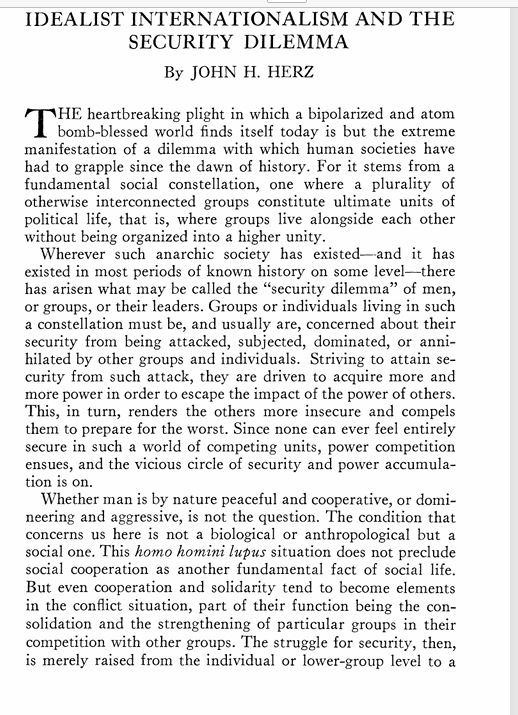
This article revisits the concept of the security dilemma—a situation where actions taken by a state to increase its security unintentionally threaten other states, leading to escalating tensions. Ken Booth and Nicholas J. Wheeler challenge traditional realist interpretations by introducing an idealist internationalist perspective, which emphasizes the possibility of overcoming the security dilemma through trust, dialogue, and cooperation. The authors argue that while the security dilemma is real, it is not inevitable. Through confidence-building measures, transparency, and ethical foreign policy, states can reduce mistrust and avoid conflict escalation. They highlight the importance of perception, communication, and moral responsibility in international relations, suggesting that peaceful outcomes depend on political will and normative commitments, not just power politics. Strengths: Offers a normative and optimistic reinterpretation of the security dilemma. Bridges realist and idealist perspectives in international relations. Emphasizes trust-building and cooperation, key for peacebuilding. Highly relevant for understanding conflict prevention at the state level. Limitations: Primarily theoretical, with limited empirical case studies. May be seen as overly optimistic in highly conflict-prone regions. Less direct focus on non-state actors or grassroots peacebuilding. This article contributes strongly to peacebuilding and conflict prevention by addressing how mistrust and fear between states can escalate into conflict. By promoting dialogue, transparency, and cooperation, it supports strategies that reduce conditions leading to instability and violence. Its relevance to extremism prevention is indirect but important, as reducing interstate conflict and insecurity can limit environments where extremist ideologies thrive. However, it does not directly address rehabilitation or deradicalization processes.