

Cooperation Under the Security Dilemma
-
 Writen byRobert Jervis
 - PublisherCambridge University Press
- Year1978
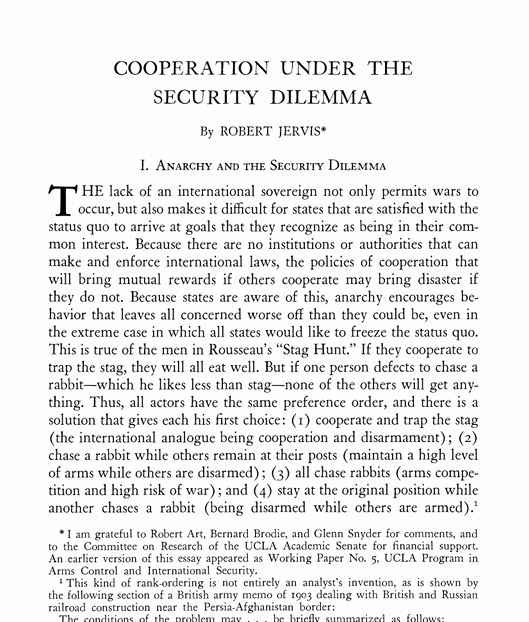
In this seminal article, Robert Jervis explores how states can achieve cooperation despite the inherent tensions of the security dilemma. He explains that when one state increases its security (e.g., military buildup), others may perceive it as a threat, leading to mutual suspicion and potential conflict—even when no side intends aggression. Jervis introduces the key concept of the offense-defense balance, arguing that the likelihood of cooperation depends on whether military technologies and strategies favor offense (attack) or defense (protection). When defense has the advantage and intentions are transparent, cooperation becomes more feasible. The article also emphasizes the role of perception and misperception, highlighting how misunderstandings can escalate conflicts unnecessarily. Jervis suggests that confidence-building measures, signaling, and restraint can help states avoid escalation and foster cooperation.Strengths: One of the most influential and foundational works in security studies. Introduces the offense-defense theory, widely used in IR. Offers a clear explanation of how cooperation is possible even under anarchy. Highly applicable to Cold War and contemporary geopolitical tensions. Limitations: Focuses primarily on state actors, less relevant for non-state extremism. Highly theoretical, with limited empirical case studies. Assumes rational actors, which may not apply in all real-world contextsThis article contributes significantly to conflict prevention and peacebuilding by explaining how mistrust and fear can escalate into conflict and how cooperation can be achieved through strategic restraint and transparency. Its relevance to extremism prevention is indirect, as stable and cooperative international environments reduce the likelihood of conflict zones where extremist groups thrive. However, it does not directly address radicalization or rehabilitation processes.